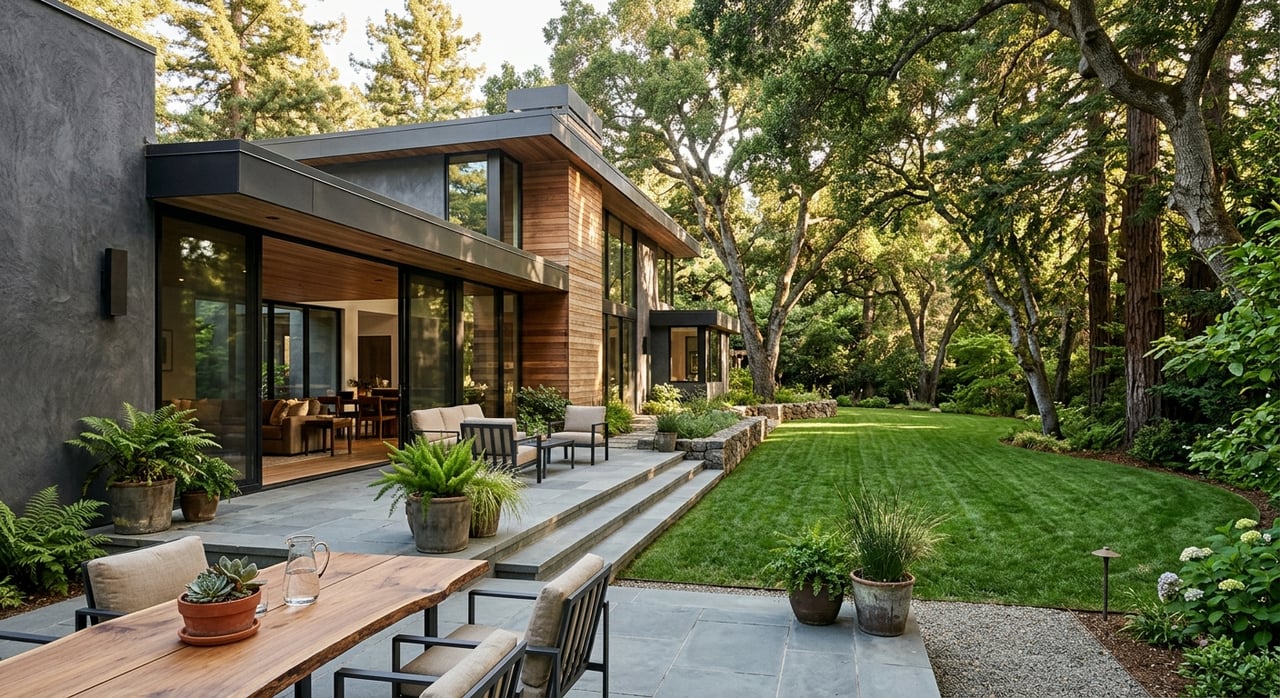
Portola Valley vs Woodside: Which Country Estate Fits You?
July 23, 2026
July 23, 2026
Trying to choose between Portola Valley and Woodside? On paper, both offer large homesites, wooded surroundings, and a rare country-estate feel within reach of Silicon Valley. But once you look closer, the day-to-day experience starts to separate. If you want to narrow the choice with more confidence, this comparison will help you understand how each town handles land, design, trails, and everyday living. Let’s dive in.
Portola Valley and Woodside are both low-density Peninsula towns shaped by privacy, open space, and custom home design. In both places, the setting matters as much as the house itself.
The difference is how each town expresses that rural character. Portola Valley is defined by wooded hills, scenic roads, open space, and design standards that emphasize blending homes into the landscape. Woodside also values scenic rural living, but its official identity leans more visibly toward village life, history, and horse-country culture.
Portola Valley describes itself as wooded hills west of Stanford, with an extensive trail system and architectural guidelines focused on preserving natural beauty. That creates a setting that often feels quiet, tucked away, and intentionally understated.
If you are drawn to estate living where the land leads and the architecture follows, Portola Valley may feel like the better fit. The town’s planning approach consistently ties development to terrain, vegetation, and grading limits.
Woodside’s official materials emphasize a rural, scenic, historic community with a strong equine heritage. That horse-country identity is not just branding. It shows up in trail planning, design review language, and the town’s overall character.
If you want a country-estate setting with a more visible village center and a stronger equestrian thread, Woodside may stand out. It still delivers privacy and open space, but often with a more outward sense of community identity.
Portola Valley has a wide range of residential density districts, from 7,500 square feet and 15,000 square feet up to 20,000 square feet, 1 acre, 2 acres, 2.5 acres, 3.5 acres, 5 acres, and 7.5 acres. The town states that the density district sets the minimum lot size.
What matters more than the number alone is how the town treats the land. Portola Valley’s subdivision and zoning rules tie lot layout to terrain conditions, usable building sites, vegetation, and limits on excessive grading. In practical terms, that often makes homes feel closely tied to the contours of the site rather than placed on a standard lot pattern.
Woodside’s Housing Element shows several different residential patterns. Its R-1 zone has a 20,000-square-foot minimum lot size, the SR zone is one acre, and the RR zone is three acres.
The same town document also notes that many older R-1 parcels are smaller, often between 5,000 and 15,000 square feet. It also points out that some areas, such as Woodside Glens, include smaller lots with challenging shapes and topography. That suggests a broader internal mix of parcel sizes and neighborhood conditions.
If consistency, privacy, and a strong estate-oriented land pattern are high on your list, Portola Valley may feel more aligned. If you want a town with more variation in lot size and neighborhood form, Woodside may offer a wider spread of options.
This is especially important if you are comparing homes based on expansion potential, site usability, or how much of the property feels naturally integrated versus more traditionally parceled.
Portola Valley’s Architectural and Site Control Commission exists to preserve visual character, protect public safety and property values, and limit excessive grading and tree removal. The town’s design goal is clear: residences should minimize disturbance to natural terrain and vegetation while preserving open space and natural beauty.
For buyers, that usually translates into a more restrained visual environment. Homes are typically expected to sit quietly in the landscape rather than dominate it.
Woodside’s Architectural and Site Review Board also reviews residential applications for site planning, building design, landscape elements, and community character. Its code emphasizes protecting rural character and natural beauty.
Woodside’s design guidance also highlights open, compatible fencing and the preservation of rural views and oak-woodland scenery. That creates a similar custom-home environment, but one with more visible ties to rural heritage and equestrian use.
Neither town is a tract-home market. Both favor custom homes, thoughtful site planning, and landscaping that works with the land.
Still, there is a subtle difference. Portola Valley often reads as more landscape-integrated and understated, while Woodside often reads as more heritage-driven and equestrian in tone.
Portola Valley’s trail network is one of its defining features. The town says it has more than 36 miles of unpaved trails and paved paths, and notes that the system is nearly as extensive as the road network.
That matters because the trails are not treated like a distant amenity. The town highlights connections to places like Windy Hill, Coal Mine Ridge, and Safe Routes to School, which makes outdoor access feel woven into daily life.
Windy Hill is especially notable for local buyers. Its lower parking area is on Portola Road, and overflow parking is at Portola Valley Town Center, tying one of the area’s best-known preserves directly to the town’s everyday geography.
Woodside also has a strong trail culture. The town says it maintains about 30 miles of trails and 36 miles of bikeways, and its Trails Committee is focused on protecting a public equestrian and pedestrian trail system.
The equestrian element is more front-and-center here. Woodside’s own horse guide notes that many residents keep horses or have horse-capable property, reinforcing the town’s horse-country identity.
Woodside also offers access to nearby recreation areas such as Wunderlich Park and Thornewood Preserve. Wunderlich is described by San Mateo County as a hillside area with redwood forest, meadows, oaks, and trails for hiking and horseback riding, while Thornewood Preserve offers easy hikes and horseback rides above Woodside.
If you want trails that feel deeply embedded in neighborhood life, Portola Valley has a strong case. If you want trails with a more visible horseback-riding culture, Woodside may be more compelling.
Both towns support an outdoor lifestyle. The difference is whether you picture that lifestyle as quiet trail access from a wooded setting or as part of a broader horse-country identity.
Portola Valley encourages commercial activity mainly to meet resident needs. Its local business mix includes everyday services such as a grocery store, hardware store, restaurants, equestrian services, and professional offices.
At the same time, the town’s planning materials make clear that residents often rely on nearby commercial areas for more specialized shopping and services. Those include centers like Ladera Country Shopper, Nathhorst Triangle, Town Center, Sharon Heights, and the broader Stanford and Palo Alto shopping area.
That gives Portola Valley a quieter, more dispersed errand pattern. You have local basics, but many day-to-day routines extend beyond town.
Woodside’s Town Center is a more defined village hub. The town describes it as a 17-acre center with a grocery store, hardware store, restaurants, shops, offices, and Town Hall.
The town is also studying parking, circulation, walkability, public amenities, and housing opportunities in the Town Center area. That points to a more visible central core in everyday life.
If you want a stronger village-center routine, Woodside may fit better. If you prefer a quieter pattern where local conveniences exist but the town remains less centered on commercial activity, Portola Valley may feel more natural.
Neither town is built around big retail. The choice is more about whether you prefer a defined hub or a more low-key local network.
Portola Valley may be the better fit if you value:
Woodside may be the better fit if you value:
The best choice often comes down to how you want the setting to shape your daily life. Do you want your home to disappear into the hillside and trail network, or do you want that same country-estate quality with a more visible village and equestrian culture?
If you are weighing Peninsula lifestyle markets at this level, details like lot configuration, trail access, design review, and errand patterns can matter just as much as square footage. That is where a local, property-by-property comparison becomes valuable.
If you want help comparing estate properties, lot character, or lifestyle fit across San Mateo County and the Peninsula, connect with Matt Aragoni.
Stay up to date on the latest real estate trends.
I am your San Mateo County Real Estate Expert, growing up San Mateo County has given me a highly specialized insight into the local markets here. I provide my clients/network with the most up-to-date market info, local expertise, and 5 Star Quality Client Service.